Abstract
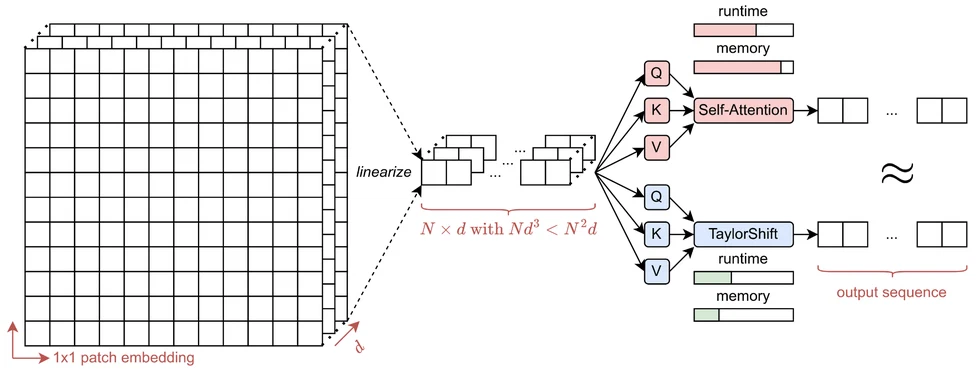
Transformer-based Super-Resolution (SR) models have recently advanced image reconstruction quality, yet challenges remain due to computational complexity and an over-reliance on large patch sizes, which constrain fine-grained detail enhancement. In this work, we propose TaylorIR to address these limitations by utilizing a patch size of 1x1, enabling pixel-level processing in any transformer-based SR model. To address the significant computational demands under the traditional self-attention mechanism, we employ the TaylorShift attention mechanism, a memory-efficient alternative based on Taylor series expansion, achieving full token-to-token interactions with linear complexity. Experimental results demonstrate that our approach achieves new state-of-the-art SR performance while reducing memory consumption by up to 60% compared to traditional self-attention-based transformers.
This work builds on the TaylorShift attention mechanism.
For more information, see the paper pdf.
Citation
If you use this work, please cite our paper:
@inproceedings{Nagaraju2026_A_Low_Resolution_Ima,
  author = {Nagaraju, Sanath Budakegowdanadoddi and Moser, Brian Bernhard and
            Nauen, Tobias Christian and Frolov, Stanislav and Raue, Federico and
            Dengel, Andreas},
  booktitle = {Pattern Recognition (ICPR 2026)},
  doi = {10.1007/978-3-032-31335-5_6},
  isbn = {9783032313355},
  location = {Lyon, France},
  month = {8},
  pages = {77--89},
  publisher = {Springer Nature Switzerland},
  series = {Lecture Notes in Computer Science},
  title = {A Low-Resolution Image is Worth 1x1 Words: Enabling Fine Image
           Super-Resolution with Transformers and TaylorShift},
  year = {2026},
}