Abstract
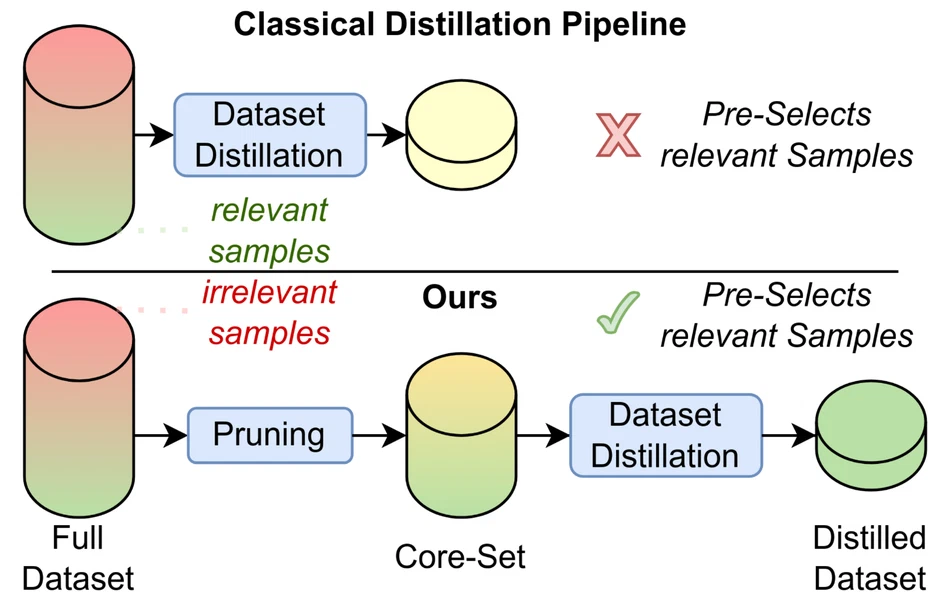
Dataset distillation has gained significant interest in recent years, yet existing approaches typically distill from the entire dataset, potentially including non-beneficial samples. We introduce a novel "Prune First, Distill After" framework that systematically prunes datasets via loss-based sampling prior to distillation. By leveraging pruning before classical distillation techniques and generative priors, we create a representative core-set that leads to enhanced generalization for unseen architectures - a significant challenge of current distillation methods. More specifically, our proposed framework significantly boosts distilled quality, achieving up to a 5.2 percentage points accuracy increase even with substantial dataset pruning, i.e., removing 80% of the original dataset prior to distillation. Overall, our experimental results highlight the advantages of our easy-sample prioritization and cross-architecture robustness, paving the way for more effective and high-quality dataset distillation.
For more information, see the paper pdf.
Citation
If you use this work, please cite our paper:
@misc{moser2024distillbestignorerest,
  title = {Distill the Best, Ignore the Rest: Improving Dataset Distillation
           with Loss-Value-Based Pruning},
  author = {Brian B. Moser and Federico Raue and Tobias C. Nauen and Stanislav
            Frolov and Andreas Dengel},
  year = {2024},
  eprint = {2411.12115},
  archiveprefix = {arXiv},
  primaryclass = {cs.CV},
}