Publications / Andreas Dengel

Andreas Dengel.

DFKI

RPTU Kaiserslautern–Landau

↗ Website

Co-authored Publications: 14

TextTeacher: What Can Language Teach About Images? figure
Preprint · 2026

TextTeacher: What Can Language Teach About Images?

Tobias Christian Nauen, Stanislav Frolov, Brian Bernhard Moser, Federico Raue, Ahmed Anwar, Andreas Dengel

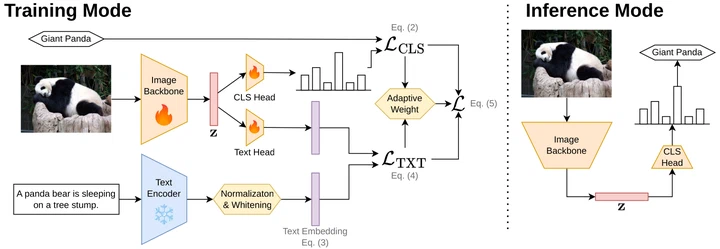
We use a frozen text encoder on image captions as a lightweight training-time auxiliary objective for image classifiers. The text components are drop.p.ed at inference, leaving a fast, unimodal vision model. Accuracy on ImageNet improves by up to +2.7 p.p. and downstream transfer by +1.0 p.p. on average, outperforming vision knowledge distillation at a fraction of the compute.

When Pretty Isn't Useful: Investigating Why Modern Text-to-Image Models Fail as Reliable Training Data Generators figure
Accepted to CVPR 2026 · 2026

When Pretty Isn't Useful: Investigating Why Modern Text-to-Image Models Fail as Reliable Training Data Generators

Krzysztof Adamkiewicz, Brian Bernhard Moser, Stanislav Frolov, Tobias Christian Nauen, Federico Raue, Andreas Dengel

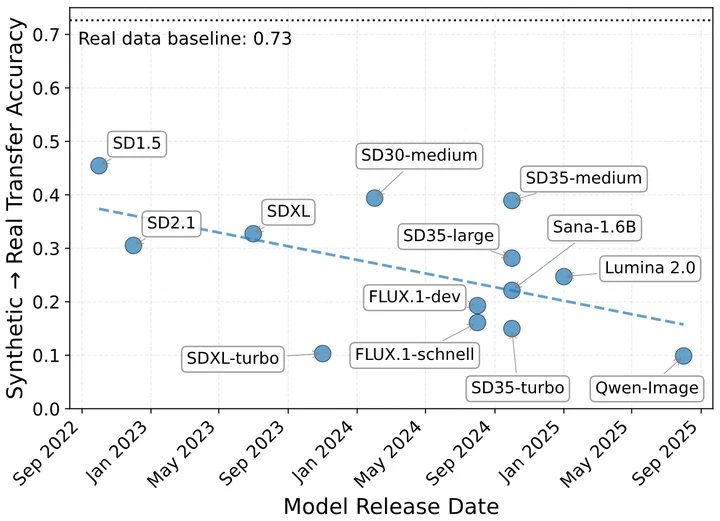
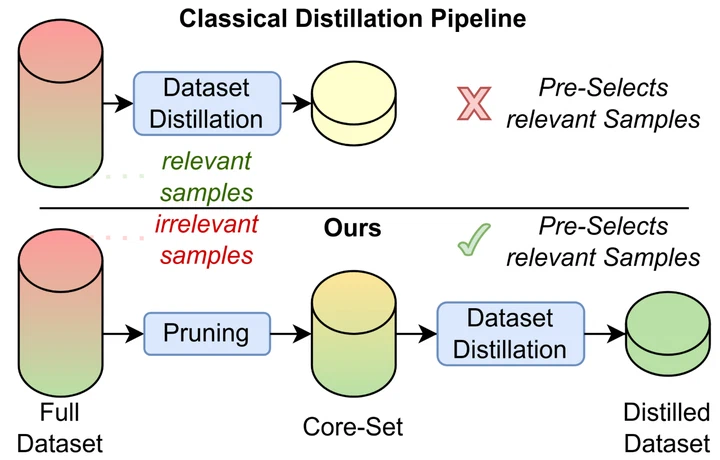
We show that newer text-to-image models are progressively worse as training data generators, despite better visual quality, because they collapse to a narrow aesthetic-centric distribution that diverges from real data.

Which Transformer to Favor: A Comparative Analysis of Efficiency in Vision Transformers figure
WACV 2025 · 2025

Which Transformer to Favor: A Comparative Analysis of Efficiency in Vision Transformers

Tobias Christian Nauen, Sebastian Palacio, Federico Raue, Andreas Dengel

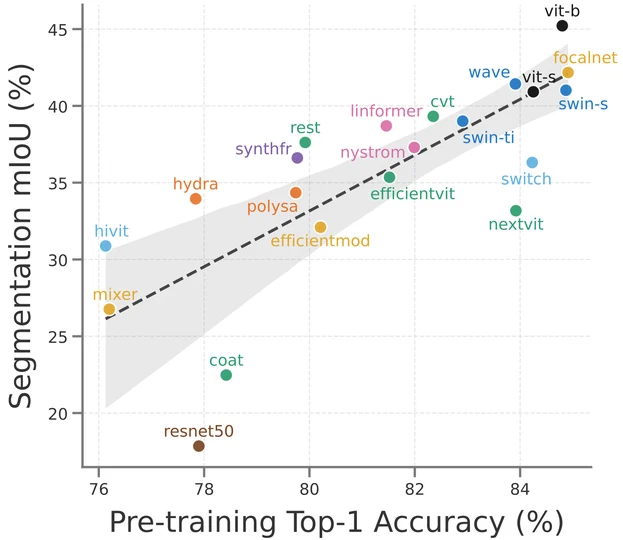
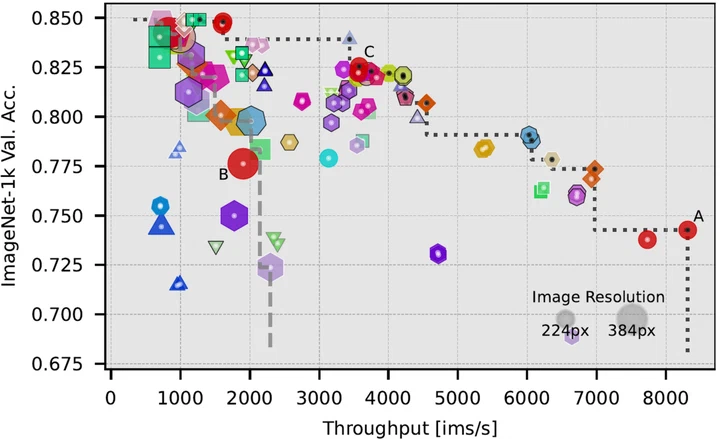
A comprehensive benchmark and analysis of more than 45 transformer models for image classification to evaluate their efficiency, considering various performance metrics. We find the optimal architectures to use and uncover that model-scaling is more efficient than image scaling.

TaylorShift: Shifting the Complexity of Self-Attention from Squared to Linear (and Back) using Taylor-Softmax figure
ICPR 2024 (oral) · 2024

TaylorShift: Shifting the Complexity of Self-Attention from Squared to Linear (and Back) using Taylor-Softmax

Tobias Christian Nauen, Sebastian Palacio, Andreas Dengel

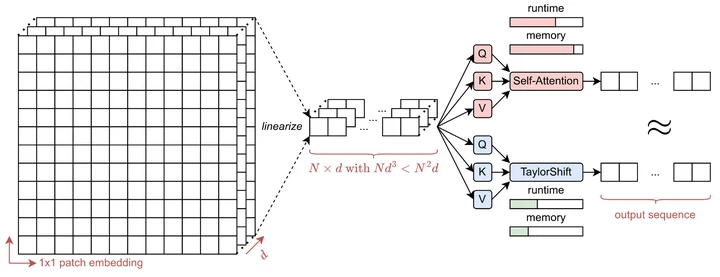
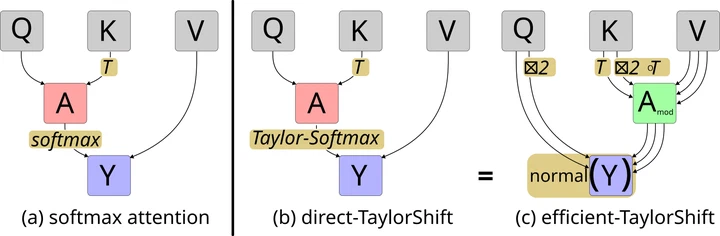
This paper introduces TaylorShift, a novel reformulation of the attention mechanism using Taylor softmax that enables computing full token-to-token interactions in linear time. We analytically and empirically determine the crossover points where employing TaylorShift becomes more efficient than traditional attention. TaylorShift outperforms the traditional transformer architecture in 4 out of 5 tasks.